Australia's climate is perfect for solar charging — but choosing the right solar battery charger setup matters. From portable panels for camping to fixed MPPT controllers for caravans and 4WDs, we've reviewed the best solar charger options available in Australia right now.
🔗 Affiliate Disclosure: ChargeWiseHub earns a commission from qualifying purchases at no extra cost to you. Learn more.
☀️ Top Picks at a Glance
🏆 Best Overall
Renogy 100W + MPPT
100W monocrystalline panel paired with a 20A MPPT controller. The most popular solar setup for 4WD and caravan use in Australia.
Renogy is a well-known solar brand for 4WD and caravan use in Australia, and the 100W monocrystalline panel bundled with a 20A MPPT controller is the best starting point for any off-grid setup. The high-efficiency monocrystalline cells perform well in partial shade and low-light conditions, which matters during Australian winters in southern states.
The MPPT controller extracts up to 30% more power from the panel compared to cheaper PWM controllers — a real-world difference when you're relying on solar to run a fridge or lights. The full kit is competitively priced at around $199 and is widely available across Australia.
★★★★★ 4.8/5 · 10A MPPT Solar Controller · Australian Brand
If you already have a solar panel and need a quality MPPT controller, the Projecta SC110 is the best value option in Australia. It supports AGM, lithium, and gel battery profiles and includes an LCD display for monitoring charge status. Being an Australian brand, you get solid local warranty support and wide availability at Supercheap Auto and Repco.
For anyone who parks their car, boat, or caravan for extended periods, a simple 10W solar trickle charger that plugs into the 12V cigarette socket is a brilliant low-cost solution. It won't fully charge a flat battery, but it keeps a healthy battery topped up indefinitely — preventing the slow discharge that kills batteries left standing for weeks.
☀️ How Much Solar Do You Need to Charge a Battery?
Solar sizing comes down to simple arithmetic, and almost everyone overestimates what a panel will deliver. A 100W folding panel in real Australian conditions realistically produces 50 to 70W for four to five usable hours a day — call it 25 to 35Ah into a 12V battery on a good day, less if it's hot, shaded, or flat-mounted.
Panel size
Realistic daily output (12V)
Suits
10 – 20W
2 – 6Ah
Trickle charging a stored vehicle or boat battery
50W
12 – 18Ah
Keeping a small 50Ah camp battery topped up
100W
25 – 35Ah
Running a fridge intermittently on a 100Ah battery
200W
50 – 70Ah
Fridge plus lights and devices, 100–200Ah bank
400W+
100 – 140Ah
Long off-grid stays, 200Ah+ lithium banks
Work backwards instead: add up what you use in a day (a 40L fridge cycling in 30 degree heat is roughly 40 to 50Ah), then size the panel to replace that plus ten percent headroom. If the number looks too big, the honest answer is more battery capacity or less load, not a bigger sticker on the panel.
⚙️ MPPT vs PWM: Does the Controller Actually Matter?
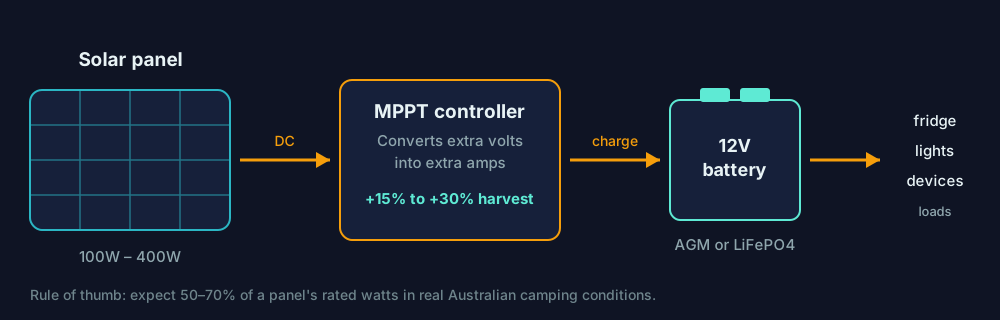
The solar charging chain: panel, controller, battery, loads. The controller is what stops the panel from overcharging your battery.
Yes, and it is the difference between a panel that works and one that disappoints.
PWM controller
MPPT controller
How it works
Pulls panel voltage down to battery voltage, wasting the difference
Converts the extra voltage into extra current
Efficiency gain
Baseline
Typically 15 – 30% more harvest, more in cold or overcast conditions
Best for
Very small panels (under 20W), tight budgets
Anything 50W and up, and any panel wired more than a few metres away
Cost
$20 – $50
$60 – $200
A 100W panel on a PWM controller throws away 20 to 30W every hour. Over a five hour day that is about 10Ah you paid for and never received. If you're buying a panel of any real size, buy MPPT.
🧰 Panel Types: Which Shape Suits Which Job
Folding panels are the touring standard: they pack into a bag, angle toward the sun, and typically come with a built-in regulator and Anderson lead. Best all-round choice for 4WD and caravan use.
Solar blankets are lighter and take up less room than folding panels, at the cost of durability. Good for hikers and swag campers who move every day.
Fixed roof panels suit caravans and camper trailers with permanent mounting. They are convenient and secure, but flat-mounted panels lose output because they never face the sun properly.
Trickle panels (5 to 20W) exist for one purpose: keeping a stored battery from self-discharging. They will not charge a flat battery, and any product claiming otherwise is overselling.
🔋 Matching Solar Charging to Your Battery Chemistry
AGM and lead-acid batteries want a proper three-stage solar charge, and they are forgiving about fluctuating input. Look for a controller with selectable AGM and flooded profiles and a temperature sensor, because charging voltage needs to drop in hot weather.
LiFePO4 batteries need a controller with an explicit lithium profile — usually 14.2 to 14.6V absorption and no float stage. They also stop accepting charge below 0°C, so a solar setup on a lithium battery in a cold-climate camp will simply do nothing until the battery warms up. That is protection working, not a fault.
A practical tip: many DC-DC chargers (the REDARC BCDC and Projecta IDC ranges included) accept a solar input directly and handle the regulation themselves. If you already own one, you don't need a separate solar controller — just match the panel's open-circuit voltage to the charger's solar input limit.
⚠️ Where Solar Charging Goes Wrong
Shade. A single leaf shadow across a panel can cut output by more than half. Move the panel through the day.
Flat mounting. A panel lying horizontal in winter loses a large share of its output. Angle it toward the sun.
Undersized cable. Long runs on thin cable bleed the volts you just generated. Short and thick beats long and thin.
No regulator. A bare panel straight to a battery will overcharge and destroy it.
Judging by the sticker. Rated watts are laboratory figures. Expect roughly half in real camping conditions and you'll size correctly.
💡 Three Solar Setups, Three Sensible Buys
Your setup
What we'd buy
Why
Keeping a stored car, boat or ride-on topped up
10W trickle panel with regulator
Cheap, set and forget, stops self-discharge
Weekend camping with a 100Ah AGM
Renogy 100W folding panel + 20A MPPT
Real output from a portable kit, MPPT harvests the extra volts
Caravan or camper with a permanent roof panel
Projecta SC110 MPPT controller
Handles larger arrays, selectable battery profiles, Australian support
❓ Frequently Asked Questions
What is the best solar battery charger for a car in Australia?
The Projecta SC110 is a popular choice for car and caravan solar charging — a 10A MPPT controller handling AGM, gel, and lithium batteries efficiently. For a complete kit, Renogy's 100W panel + MPPT bundle is hard to beat.
Do solar battery chargers work in cloudy weather?
Yes, but at reduced output. Solar panels still generate power on overcast days — typically 10–25% of rated capacity. MPPT controllers maximise output in low-light conditions.
What size solar panel do I need to charge a 12V battery?
For a 100Ah 12V battery, a 100W–200W solar panel with an MPPT controller will provide a full charge in 4–6 hours of good sunlight.
Can I use a solar charger without a controller?
Small trickle panels under 5W can be used without a controller as a maintenance charger. Anything larger requires an MPPT or PWM controller to prevent overcharging.